

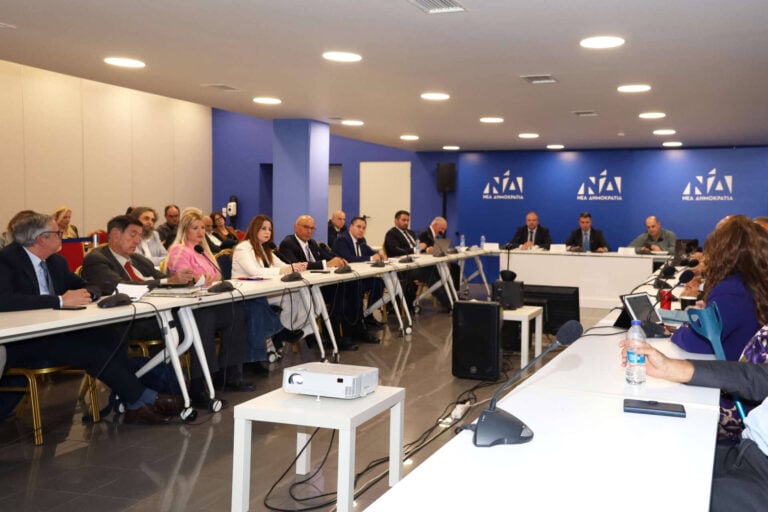
Renowned Greek Australian lawyer Yiannis Tripidakis made an important contribution at the New Democracy roundtable discussion on the topic of “Connecting Greeks in the Diaspora with Greek Business”.
The event was organised by the Secretariat of Productive Bodies & Entrepreneurship and the Secretariat of Greeks in the Diaspora, with the participation of high-ranking government officials, such as the Secretary General for International Economic Relations and Extroversion of the Ministry of Foreign Affairs, Dimitris Skalkos, and the Secretary of the New Democracy Party, Kostas Skrekas.
The panel was attended by representatives of transnational chambers as well as entrepreneurs of the Greek Diaspora, who shared their experience and highlighted the perennial obstacles faced by those wishing to do business in Greece.
From the Australian side, Tripidakis clearly and documented his position on three critical issues that directly concern the interconnection of the Greek diaspora with the Greek state.
First, he highlighted the pending bilateral agreement between Greece and Australia to avoid double taxation, an issue that discourages investment and economic mobility.
As he stated, the delay in completing the agreement creates uncertainty for businessmen, professionals and individuals operating between the two countries.
Second, he pointed out the significant obstacles that expatriates encounter in obtaining a Greek passport and protecting their real estate in Greece – issues that often require time-consuming and expensive procedures, preventing the maintenance of close ties with the homeland.
Third, he referred to the recent legislative regulation that provides for the submission and publication of wills through Greek consulates, either under Greek or Australian law. According to him, this regulation, if properly implemented, can significantly simplify inheritance law procedures for Greeks in the Diaspora.
Yannis Tripidakis’ points clearly highlighted that the essential Diaspora-Greece interconnection cannot be based solely on goodwill, but requires specific institutional solutions, operational mechanisms and political will.